Sunday, February 14, 2016

SCODland


Several years ago we acquired our initial herd of Nigerian Dwarf goats.  It was fun watching their behavior towards each other as well as their interactions with us and our four dogs that we had at the time.  Those observations inspired a little story about herd behavior.  

Welcome to SCODland (Small Country of Dwarf)
Once upon a time on a small farm in what used to be Roane County West Virginia, a small band of ruminants, tired of the tyrannical rule of the old herd queen Tenacious, began marching in the snow to call attention to her hoarding of food and shelter.   
 
Herd Queen Tenacious.
 As a result of the forcasted long winter ahead, they worried that there could be future shortages of hay and grain and were really concerned about the impending lack of fresh browse.  
In a capricious uprising, marred only by occasional head butting, the merry Nigerian herd seceded from Roane County, West Virginia  and formed SCODland otherwise known as Small Country of Dwarf.  They initially wanted to call their fledgling country Nigeria but it was gently pointed out that that name was already taken. 
Being of herd mentality, they decided they wanted to retain the Monarchy but in a bold move, appointed the two-legged creatures as supreme rulers, in effect deposing the tyrannical Queen Tenacious.   


The young females decided that the time was right since Queen Tenacious was becoming very rotund as a result of her impending delivery of the Prince or Princess (or both or several) of SCODland and would be unable to mount sufficient resistance.  


 It was agreed that the female two-legged creature (formerly known as Shelley) who was responsible for providing everything from shelter to food would henceforth be addressed as "Queen of the Small Country of Dwarf".   
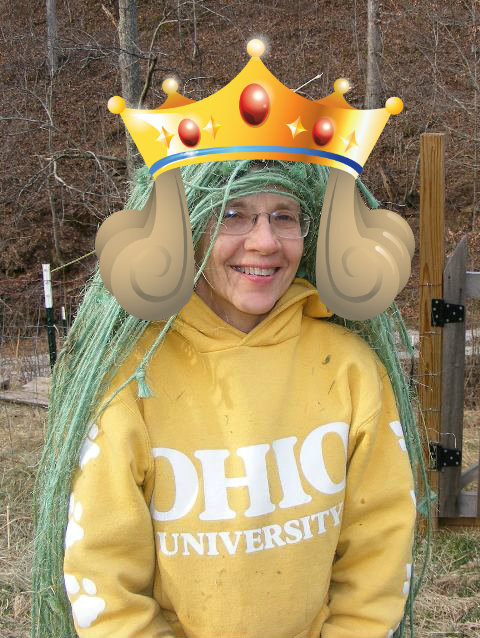
 
Queen Shelley.
Also, the male two-legged creature (formerly Don) who is ancillary to the queen in terms of providing for the subjects would henceforth be addressed as "King of the Small Country of Dwarf".  
 
King Don.
Since a smooth transition of power was desired, the canine known as Ace, would remain as head of Security and would stay at his current duty station high on the hill overlooking SCODland, ever vigilant for intruders.  
 
Ace, always at the ready.
 Moose was appointed Chief Ambassador would formally announce all visitors to SCODland with a resounding (and never ending) WOO-WOO.   
 
Ambassador Moose with his entourage.
His deputy Ambassador, Tia, was charged with bestowing slimy toys upon any visitors.   
 
Moose!  Where are the visitors so that I can bestow my slimy toy?


Self-appointed dog mother Trixie will act as Nanny to the baby SCODlets who will be arriving next month.   


It is hoped that the current regime will result in greener pastures for everyone, say around April or so.

Saturday, February 13, 2016

MIlk Your Goat All Winter

Everyone that knows me knows that I LOVE milk...and yogurt and cheese and well just about everything dairy.  I have to admit that I am still working to like kefir but my husband loves it.  Our love of dairy is the reason we started with dairy goats in the first place.  Now that we have enjoyed these fabulous, amusing creatures for several years, there are so many more reasons to love them, but I digress.

Generally, standard-size goats kid in the winter/spring, are bred in the fall while still in milk, and then dried up after about about 10 months of milking.  Kids arrive again in the winter/spring and the cycle is repeated.  Many homesteaders however, want and need year around production.  One way to do that is to have Nigerian Dwarf goats that breed year around.  We have those.  Another way is to use hormone implants with standard size goats to regulate their estrus cycles,  We don't do that.  What one can do though is milk those big (and little if you want to) goats through the winter and not breed them in the fall.  This is a pretty common practice but this is the first year I have tried doing so.

I have one standard goat, a LaMancha and now that she is mature I thought I would try "milking through" or do an "extended lactation" as the practice is often called.  I consulted with my friend Becky at 5 and 20 Alpines who has been using extended lactations for a while.  In general the idea is to have two (or more) goats and breed them every other year (or even every two years).  This way, when one is still milking, the other is dried off and pregnant.  Once the second doe kids, the milking doe is dried off to prepare for her pregnancy and so the cycle continues.  I really didn't want to buy any dairy products this winter (well except butter) so I thought I would try "milking through" to see what happens.   I am so happy to report that my beloved Starr (I have to put the beloved in there) has been in milk for 12 months and is milking the perfect amount for us.  Her spring/summer production is over a gallon a day which keeps me very busy in the cheese kitchen.  Her winter production is about half that (5 pounds now) or a little more than 1/2 gallon a day.  Generally production will increase as spring approaches but never reaches peak production levels.  I'm sure there are exceptions. And right on cue with the approaching longer days, my beloved Starr is slowly increasing production.  Also some does will do a very extended lactation and milk for years.  I believe Becky has an Alpine that she expects to milk for 27 months.  Fantastic!!  Becky mentioned that she feeds sweet potatoes, cabbage, pumpkins, kale, and turnips in the winter months to help maintain production.  I think her goats eat better than we do!  Luckily we grow lots of sweet potatoes and also we grow butternut squash that I feed all winter.


Oh yeah I think we have squash covered!  They are ridiculously easy to grow, store well and the goats love them.  Of course I cut them up in to bite-sized pieces for my beloved Starr and I feed a quart container of them to her at milking time.  She gets her grain but she LOVES her sweet potatoes and squash.  If I am milking and forget to add them to her dish she ever so gently snorts at me until I give her squash.  I hope we don't have any squash crop failures in our future.


Tuesday, January 19, 2016

Life is a Journey

It will soon be time to say goodbye to our 62 acre farm that has been our home for 15 years.  We started here with a 100 year old house in need of much repair, an old barn that deperately needed a new roof and a lot of optimism. Our love of the property with its 15 foot waterfall along the driveway blinded us to the reality of what might would be required to modernize the old house so it would be comfy and cozy.  In fact we had originally planned to build a new house in a different location but we loved the setting of the old house that overlooked the barn and large garden area.  Two massive trees provided shade from the summer sun and there always seemed to be a pleasant breeze on hot afternoons.  The decision to keep the existing house set in motion a 5 year journey of renovation, rebuilding and discovering talents and skills we didn't know we possessed.

Our new farm is 2 miles of bouncy, back road from our original home in the woods.  We commuted 30 minutes one-way, back and forth in our faithful Toyota truck.  In very rainy or snowy weather the commute was impossible since part of the road was creek bed.  It was either flooded or frozen making travel nearly impossible.  On those days we had no choice but to stay home.

Over time we reframed entire exterior jenny lind walls, replaced roofs, replaced floor joists and tore down assorted additions that did not work for us.  We replaced all the plumbing, all the wiring and built our kitchen and bath cabinets.  We installed a water system which automatically pumps water from our spring, to our cistern, and into our house.  Once we had hot water we moved in.  Inside finishing continued for another 2 years.  We slept in whatever area of the house that had a spare spot to fit a bed.  We had a "temporary" kitchen that lasted for a year and a half.  The upstairs bedrooms were the work area and housed lumber and tools.  There were no stairs.  Fortunately there was ground level access to the upper floor.  One summer Don built the stairway, using creek stone to make a unique access to the upper floor.


Once we decided to raise dairy goats and chickens, we began another contruction period, adding various sheds, coops, small barns, and fences.  Now that we have a functional homestead it is time to move.  Isn't that always the way it is.

Our move is local. We will just be a lot closer to town with easy access.  At this stage of our lives we decided it was time to simplify and downsize onto a property that would see us into our old age.  We will still have dairy goats, a garden and an orchard.  We are enjoying planning new facilities, a new garden,  and working on projects again.  In the near future we will have to sell the farm into which we have poured much blood and sweat.  It will be a sad day in some ways but change is a spring board to new experiences.  We are both looking forward to this next phase of life.

Tuesday, January 12, 2016

Transitions

As the name implies, this has been a very intermittent blog, nearly two years in fact since my last post.  It seems as though I just ran out of things worth saying.  However, 2016 brings some exciting news.  We are moving Twiggity Farm!  We moved to West Virginia 20 years ago following careers in the earth sciences.  In a somewhat spontaneous, think with your heart and not your head decision, we bought the most backwoods, off-the-beaten path homestead we could find nestled (or maybe more accurately, crammed) into the steep hills of Roane County. From the very first day of the move we realized this was going to be an adventure of epic proportions for this now ex-suburban couple.  But before we look ahead to the future, here is a glimpse of our first homestead where we lived for 5 years.

Driveway.

More driveway.

Our 7-sided house.

The "facilities".  The only facilities.

Our kitchen with matching 1930's gas and wood stoves.

The bathing facilities complete with gas burners.  Buckets were required for "showers" although in summer you could parttake in a refreshing outdoor shower.

Winter.

Driveway in winter.

Wednesday, March 5, 2014

February Recap

Since it appears that I somehow missed the entire month of February I'll attempt to recap:


February 2
My Nigerian doe 17 Syllables had four beautiful babies.  I brought the two does inside so I could bottle feed them exclusively.  I left the two boys with their momma.

The two boys.


The little doeling we kept.


This little girl went to Indigo Acres Farm.


February 3
My Alpine doe Diesel had buck/doe twins.  I brought them in the house to bottle feed so I could milk her.
The doeling Kay Kay.


The sweet little buckling Bit O Honey.


Lets see, with Snicker's three January kids already in the house and the addition of four new ones, that made 7 babies running around inside an x-pen in my sunroom.  It looked something like this:


This is apparently what happened to a lot of February.  We bottle fed babies 6 times a day, cleaned crates,  mopped floors and got into a routine of milking two goats again.  We sold one of the Nigerian bucklings to an experienced goat owner as a bottle baby and three other Nigerian bottle kids went to a new home too.  As the 4 remaining kids grew (which they do at an astonishing rate) I spent more and more time matching wits with their ability to jump and climb.  I am still winning but just barely.

Usually I try to get kids to the kid pen outside long before a month of age.  For the first couple of weeks though, the kids are bottle fed every two and three hours (except overnight) so it is handy not to have to run to the barn with bottles every few hours.  The weather this winter, however, just wouldn't allow a transition from a heated house to an unheated barn so at over a month old they are still in the sunroom.  The occasional breaks in the weather were spent doing various outside chores such as cleaning pens, moving goats around to kidding stalls, giving vaccinations, trimming feet and even going to town to replenish supplies.  We also spent a couple of lovely hours on our deck during warm afternoons watching the babies run and play OUTSIDE.


Sometime during that February blur, the two mini-alpine kids also went to their new home, we bought a breeding pair of guineas and I started making cheese and yogurt again. Don was able to restart his kefir culture too.  Our Alpine Diesel gives a lot of milk (well over a gallon a day), so we have enough to easily feed bottle babies, drink, and make cheese.  I save my Nigerian milk for yogurt since it makes THE BEST thick and creamy yogurt.
Thick and creamy yogurt with NO additives!


I think that about sums up the last few weeks.  Now we are heading into our second kidding period and will have 6 does kidding this month.  Now if I can just get these kids out of my sunroom so I can start all over again....

Monday, March 3, 2014

What happened to February?

This is post I started but never finished in a timely manner.  These darn cute kids that this post is about just kept keeping me busy.  So another month has passed and it is March.  So now I will finish the post I started on Jan 28th.
  
Flashback to January 28, 2014:

Well this morning it is below zero - again.  Snickers, my first doe to kid this season, did me the most wonderful favor and kidded on Sunday afternoon during the warmest part of the day on the warmest day we have had for a week.  Temperatures were actually above freezing and the skies were clear.  I had been doing some outside chores in the warmth of the high 30's and had noticed that Snickers was more restless than usual.  Since she had reached day 147 in a 150 day gestation period I knew the time was near and that we would have kids before the end of the day.  I had started feeding the goats and noticed that she was standing hunched up.  Well she was pushing kids!  We have a baby monitor in the barn so I excitedly yelled to Don who was in the house, that we had kids on the way.  I had my box of towels, puppy pads and other kidding supplies by the door.  The recipe for the molasses water was taped to the refrigerator door.  The crate was in the house and we had an empty tote lined with towels ready to take to the barn in which to place the newborn kids.  Don set about his job of mixing up Snicker's post-kidding hot drink of molasses corn syrup salt and baking soda.  He also made sure he had his notebook to record pertinent birthing information (birth order for proper tattoo sequence, description of kids etc).

By the time I retrieved my kidding box, Snickers was standing up and had pushed her first kid out, a smallish but squirming light colored kid.  These were the first kids from my new buck and I really wanted to keep a doe kid from this pairing so a quick peek confirmed it was a doe.  Yay!  I took the baby and wrapped her in a towel and gave her to Don to towel dry.  By the time I looked back to Snickers another kid was on the way, with her still standing. Out came another small squirming kid that looked a lot like the first one.  A boy.  Okay well at least we can tell them apart now.  We put the first kid in the box and started drying the second kid.  In the meantime Snickers had her third kid on the way.  This kid was larger and had a large brown patch on her neck.  Yep, that is my buck NC Promisedland RC Obama's kid.  It has moonspots!

Newborns tucked in their box.  You can see the moonspot on the middle kid's ear.


We had decided that these kids would be bottle fed in the house because I wanted to start milking Snickers right away and because the weather was forecast to be the coldest of the season with night time temperatures below zero.  Besides, we like bottle kids because they are so friendly and fun to watch romping around in the house and we have lots of time in January and February to devote to them.  And quite frankly, with the weather the way it is, I would likely not spend the time in the barn  playing and interacting with them those first few days that are so critical for raising people-friendly kids.

I had thawed some colostrum so I could feed the kids right away and allow Snickers an hour or so to pass the afterbirth before I milked her.  The kids took to the bottle after a few attempts and happily sucked down a little bit of the sticky, sweet colostrum.  Newborn kids eat often in tiny amounts so I try to mimic that feeding pattern as much as possible, feeding them a few sips every couple of hours for the first day or two.

It is common for some kids to be a bit more advanced than others and such was the case with these kids.  The little buckling was a bit slow but had a suck reflex and was eating. However, as the two doe kids were happily testing their new legs within a few hours, the little buckling was not.  Not leaving anything to chance, I administered a bit of Selenium/Vitamin E paste, gave him an injection of fortified B complex and gave him a few dabs Nutridrench, a concentrated commercial vitamin/energy boosting product. By late evening they all had consumed a few ounces of Colostrum so I tucked them into their crate and went to bed.  Newborns do fine with no food overnight and I like it that they wake up nice and eager to eat breakfast.

Fast forward a few days...
A friend at Indigo Acres is raising one doe and buck kid (he is special needs and his name is Sawyer).  I kept the moonspotted doe.   In the mean time more kids arrived from Diesel (mini-Alpines)  and quads from 17 Syllables.

I will try to summarize February in another post so I can get caught up (again).

Saturday, January 18, 2014

No Kidding Around - the Time is Near!

The 2014 kidding season is arriving sooner than ever at Twiggity Farm.  The first three does will be kidding about February 1, give or take a few days.  I am finishing up my preparations so thought I would share them with you.  I have blogged in previous years about getting ready so I'll share these links.

Kidding Season Checklist Feb 14, 2013
Waiting for Babies (March 2, 2012)
Gettin' Ready for Babies (Feb 4, 2012)
Gettin' Ready for Babies - Part 2 (Feb 9, 2012)


Because I will be milk testing this year I will likely bottle feed a few more kids than in previous years. I thought I'd share a general bottle feeding schedule for Nigerian Dwarves that I more or less follow.  Having a workable timetable is needed to help keep the babies (and you!) on a regular schedule.  That way there are
no missed feedings or tummy upsets.  I want to stress that not every schedule is right for every situation.  Generally though, very young kids need to be fed small amounts very frequently and older kids get larger amounts less often.  Below is a sample schedule for Nigerian Dwarves.  Bigger goats will need more milk on the same schedule.

Day 1:  As much colostrum as they want approximately every three hours.
Example 7am, 10am, 1pm, 4pm, 7pm and 10pm.
Day 2:  Approximately 2 to 3 ounces of milk every three hours
Example 7am, 10am, 1pm, 4pm, 7pm and 10pm.
Days 3 thru 7:   Approximately 3 to 4 ounces of milk every 4 hours
Example: 7am, 11am, 3pm, 7pm, and 11pm
Days 8 thru 14:  Approximately 4 to 5 ounces of milk every 5 hours.
Example: 7am, 12pm, 5pm, and 10pm
Weeks 3 through 5: Approximately 6 to 8 ounces of milk 3 times a day.
Example: 7am, 2pm, and 9pm
Weeks 6 to 8: Approximately 8 to 10 ounces twice a day.
Example: 7am and 7pm
After 8 weeks:  Sustain this feeding for another week or if you want to begin weaning the kids then drop the morning bottle and give 8 to 10 ounces in the evening.  Kids that seem smaller than their peers might benefit from an extra week or two on a bottle.  Keep reducing the amount of milk given in the evening until the kid is weaned at about 9 or 10 weeks.

Volumes of milk that a kid will drink vary but it is important not to let a kid overeat.  Tummies should feel full and rounded after feeding and the kid should be hungry by the next feeding.  This schedule is given as a guideline for what I do and varies widely from breeder to breeder.  Kids should also be offered hay no later than 3 weeks.  I put a tablespoon of grain out for them to try but they rarely eat much until after they are weaned. Even then it is best to get kids eating hay.  Grain is really just a supplement. 

See what is like to bottle feed kids:  These are 7-day-old Mini-Lamancha kids and are 7 days old.


Saturday, January 11, 2014

Free Gas - Part 1 (Do You even Own Your Minerals?)

The cold snap that we just experienced got me thinking about how much "free gas" has influenced our farm life.  We use it to heat our house, workshop, water and tiny seed-starting greenhouse.  We did not have gas when we moved to our present farm in 2001 and it wasn't until several years and many cords of firewood later that it became a reality.  Although free gas is relatively common in this neck of the woods, many people have never heard of such a thing.  Over the course of several blog posts I plan to explore this topic and how it affects our current farm and the one we lived on just down the road when we first moved to Island Run in 1996.


First off, please remember that I am not an attorney, or anything legal for that matter, but have experienced way more than I have cared to regarding land and mineral ownership issues in WV.  In WV, minerals are generally owned separately from the surface and were split off generations ago. It is an odd arrangement to those who are not familiar with divided ownership but to us natives it is just the way it is and has always been. Many state that have historically had minerals extracted are subject to having divided ownership.  It is in some ways similar to water rights in the west. Anyone contemplating doing anything in WV regarding land needs a GOOD real estate attorney!

If you are lucky enough to be the sole owner of the mineral rights under your property and decide you want to lease to an oil and gas producer, then you can proceed unimpeded and can negotiate various things of importance to you in the lease.  Often though, the minerals are owned by jointly many individuals, having been passed down over the generations to various heirs or sold off when times were tough. Small County Courthouses are often buzzing with attorneys trying to sort out if Dorothy, who was your great grandmother's twin sister, really did sell her mineral interest to her daughter's ex-husband way back in the 30's in order to afford to buy two hogs.  Sometimes it takes years of work to locate and resolve issues regarding these long lost heirs.

When attempts to locate and buy these miniscule owner's (often 1.5 percent or less) in your minerals fails, one of the only remaining options to settle things is a land partition suit initiated by one of the landowners.  Generally if there are unknown heirs, the property cannot be divided (or partitioned) equitably among all the owners and the property is sold on the Courthouse steps to the highest bidder.  Sometimes just the minerals are sold and sometimes it is the surface and sometimes it is both the minerals and the surface land.  The very big downside to this arrangement is that you might get out-bid by someone with deeper pockets than you and the property is no longer yours. Proceeds from the sale and I think any future income that may result on behalf of the long lost heirs is somehow escrowed  practically forever and the new owners of the land (and/or minerals) now may proceed to do what they want to with the property. The whole process regarding partition suits and unknown heirs is confusing with lots of twists and turns so please don't quote me on any of this. 

If you are not the sole mineral owner of the land you occupy or have no ownership in the minerals at all, you really have no choice in whether or not a well is drilled on your property.  The decision is up to who ever owns the minerals.  That can be a scary proposition when you are faced with what amounts to a construction project on your property that you have little to no control over.  There are a few basic set-back requirements but in general the well gets drilled where it is easiest to get the equipment to or to where the well spacing dictates it needs to be.  This is not a good thing if it is plopped down in the middle of your only tillable corn patch or your flat hay field.  The good thing is however that often free gas was negotiated into the mineral sale way back when and many folks who do not own their minerals but live on the property still get free gas.

We have experienced both situations since moving back to WV.  If you have an interest in the topic of free gas, stay tuned for Part 2.


Wednesday, January 8, 2014

Keeping Goats Warm

With the exceptional cold weather we have been experiencing I thought it would be timely to discuss keeping adult goats warm when temperatures are frigid.  A little common sense will assure that they weather a cold spell successfully.  Lets look at how our goat friends stay warm and how we can help them.

1. Dry, draft-free shelter - Goats are unlike a lot of other farm animals in that they cannot tolerate being outside when it is wet. We need to provide them protection from harsh winds and make sure they have plenty of dry bedding.  Housing need not be elaborate but it should provide protection from prevailing winds.  This small buck house opens to the south to allow winter sun to penetrate and it is closed to the north and west.  There is a wooden platform in the rear.  In really cold climates a more enclosed shelter is suitable.

2.  Winter hair - Many goats have a soft undercoat for warmth and a harsh outer coat to help trap body heat. You can see the two types of hair in the photo below.  In summer dairy goats are often clipped to remove the long outer hair and the undercoat.  One must be sure to allow plenty of time for hair regrowth as the weather gets colder.

It is hard sometimes to remember how much hair they really do grow.  Compare Betsy in the summer after clipping in June (first picture) and Betsy in December (second picture).
3.  Provide plenty of dry hay - Goats digest hay and other roughage through bacterial action in their rumen. Think of the rumen as a bacterial digester and the breakdown of fibrous materials generates internal heat.  Hay to munch on assures that the goat has plenty of material to keep the microbes active, thus generating heat.  Later on, goats can snuggle down in their bedding and chew their cud to finish the digestion process.

4.  Provide plenty of warm water -  Goats often do not drink enough water in the winter.  Warm water several times a day encourages them to consume more which aids digestions and prevents dehydration.  Sometimes Gatorade or other flavored electrolytes encourages the pickier ones to drink.  Several of mine just love hot water and they always run to a fresh steaming bucket.

5. Companions - Goats are herd animals and will often snuggle together to keep each other warm.  Even my adult bucks who are constantly posturing with each other during the day will all curl up together on a cold night.

6. Fresh air and exercise - Assuming the weather isn't too harsh goats benefit from fresh air and exercise.  My goats are generally outside for at least part of the day except when there are temperatures hovering near zero and /or there are harsh winds.   Physical activity helps generate body heat and I think encourages them to eat and drink more.  I think it is particularly important to get those pregnant does outside and moving around, at least for a few minutes a day.

By using a little common sense your goats will be warm and cozy all winter.

Tuesday, January 7, 2014

Mals-About N' Hootwire's Valentia - A tribute.


On January 4, 2014 our sweet Italian Spinone, Tia, lost her struggle with renal failure just  2 1/2 months shy of her 8th birthday.  We will always be thankful to Pat and Debbie for letting this little girl come to WV.  She was a Spinone through and through.  She was an awesome hunter, a counter surfer, a lap dog, our greeter, and she also caused more mischief than all our other dogs put together.  She would howl in sorrow every time I left the farm.  She was needy when not actively engaged but very independent when she was doing her thing. She firmly believed that white dogs were meant to be brown, hoses of all kinds were meant to be in segments, and that it was her duty to enable all the animals on the farm to roam free. We progressed through increasingly complicated gate latches, both inside and outside. She burned her candle at both ends and lived a great life on our farm.  Here is her life in pictures:

 
Working on stacking for the conformation ring.
Co-owner Debbie showing Tia at her last show in NC.
Co-owner Pat took us under her wing and helped us finish our AKC Junior Hunter title.

Tia very proud with her orange Jr. Hunter ribbons.
She was never without a toy.
She liked to play dress-up.

Did I mention she liked to hunt?
She like mud.
And snow.
And burrs LOVED her!
Run free my wild child and do all those things you loved and did so well.  You were loved and can never be replaced.

Sunday, January 5, 2014

Preparations for Below-Zero Weather


Like many others across the country we are getting ready to experience temperatures not seen for possibly decades.  I spent most of the day today preparing for temperatures forecast to be well below zero.  Although we have grid electricity, our water, natural gas, and back-up power generation are "private" and are maintained by us. 

Our water system, which consists of spring water pumped to a cistern, has a few vulnerable points that must be heated to prevent freezing.  Generally a light bulb is all that is needed but that must be checked to be sure no bulbs are burned out. 

Our free natural gas is pretty much maintenance free thanks to a well thought-out initial set up when installed by the drilling company.  Natural gas, which generally contains some moisture, is always subject to freezing, either in a low spot or at the regulator.  Fortunately that has never happened but we have not yet encountered temperatures well below zero so only time will tell if we will have a problem.  Just in case of a gas outage, we have our back up wood stove.  Tomorrow I will bring up a few armloads of wood from the woodshed to the house.

I also took the opportunity today to "exercise" our natural gas generator just make sure it was charged and ready to go.  For our electrical  backup we have a large portable generator converted to natural gas.  The wonderful thing about that is that one never has to fill the tank and it always seems to start easily as long as the battery is charged.  For more about our generator setup read about the The Quest For Power.

Don charged the battery in the old Toyota farm truck and made sure it would start.

By far the most time was spent on preparing the goat facilities.  Our barns are open to the South to capture warmth and light from meager winter sun. During extreme weather I cover the openings with tarps to keep out wind and blowing snow.  With this extreme cold due to arrive tomorrow, I closed up other windows and doors and stacked hay bales to eliminate most drafts.  I also hung a few heat lamps and brought a lot of hay from the main hay barn to the animal barns.  This will be used for eating and for making a deep layer of hay on the floor for warmth.  Goats generate body heat by digesting roughage so they will also have access to warm water which will encourage them to eat and drink.

Here is what the Nigerian barn looks like:


The other barn looks like this:
Not very pretty but it works.  Hopefully by Wednesday when the weather moderates all the goats will have weathered the cold temperatures with no ill effects.